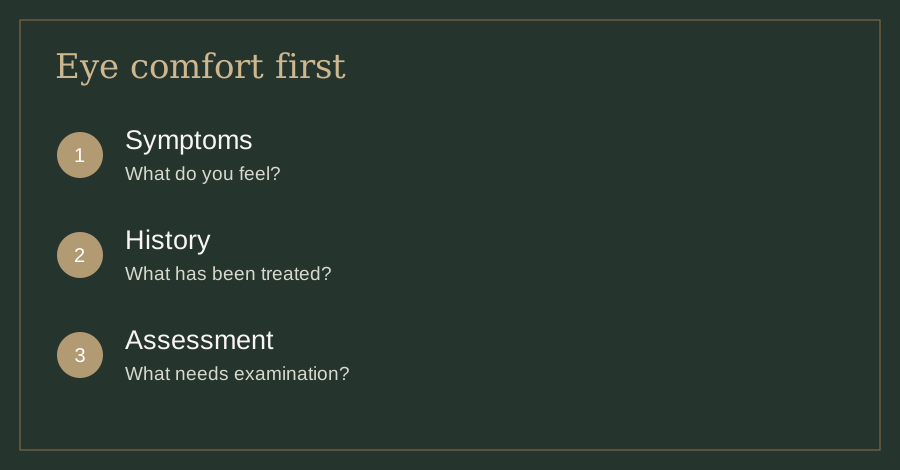
Dry-eye symptoms deserve an assessment before you commit to eyelid surgery. They do not tell you, on their own, whether an operation is suitable. The important question is whether the proposed change can preserve comfortable blinking and eye closure in your particular case. If you are travelling to Korea, raise the issue during the first enquiry so that an eye examination, existing records and any necessary treatment can be planned before a surgery date becomes a deadline.
This article helps you prepare that conversation. It is not a test of surgical eligibility, and the suggested questions do not replace an examination. The aim is to put comfort, vision and appearance into the same consultation, rather than discussing dryness only after a design has been chosen.
Describe the feeling, not only the label
The National Eye Institute explains that dry eye can occur when tear production is insufficient or tears do not work properly. Symptoms can include a gritty or burning feeling, redness, sensitivity to light and blurred vision. A clinician evaluates the symptoms and the eyes; a photograph of an attractive eyelid shape cannot provide that assessment. Read the NEI explanation.
When contacting a clinic, describe what happens during an ordinary day. Do your eyes become uncomfortable while working at a screen? Is the problem more noticeable in the morning or evening? Does one side feel different? If you already use prescribed drops, give their names and explain who prescribed them. If you have never received a diagnosis, say that you have symptoms rather than presenting your own conclusion as established fact.
A short, factual account is more useful than a long list of internet diagnoses. For example, you could explain when the discomfort began, how often it occurs, whether it interferes with reading and what treatment you have tried. You do not need to interpret the cause yourself. Leave room for the clinician to ask about details you would not have thought relevant.
Why the eyelid assessment matters
Eyelids protect the eye, and changing their position or tissue can affect how they function. The American Society of Plastic Surgeons lists dryness, difficulty closing the eyes and lower-lid position changes among potential complications of eyelid surgery. This is why the consultation should include more than the height of a crease or the amount of visible skin. Review the ASPS risk information.
Ask the surgeon to explain how your existing eye comfort affects the proposed operation. A useful answer should relate to what they have examined, not simply reassure you that dryness is common. Ask which findings might change the design, reduce the scope of surgery, prompt another specialist assessment or lead to postponement. Those are different possibilities, and none can be chosen responsibly from a general article.
Avoid treating a conservative recommendation as an incomplete service. If a clinician advises against a change you initially wanted, ask them to explain the trade-off. Understanding what they are trying to preserve can be more valuable than obtaining agreement to the largest visible alteration.
Build an eye-health history before the appointment
Bring a record of previous eye and eyelid procedures, including laser vision correction, earlier cosmetic surgery and any treatment for an eye condition. Include the approximate date and the treating practice when known. If you have existing eye-examination reports, ask the receiving clinic which parts it needs and whether a translation is required. Do not assume that sending an old report removes the need for a current examination.
List prescription medicines, non-prescription products and supplements accurately. Tell the clinician about allergies and the treatments you use around your eyes. Do not stop a prescribed medicine to make yourself appear ready for surgery. Medication changes need instructions from the responsible clinicians, taking account of why you take the medicine in the first place.
The Australian Society of Plastic Surgeons specifically includes dry eyes, eye-drop use and visual disturbances in its discussion of information to share before eyelid reduction surgery. Its advice supports being open about symptoms rather than trying to complete a booking first. Read the patient information.
If you wear contact lenses, mention this and ask how to prepare for the assessment. Also explain whether your symptoms affect lens tolerance. Keep the answers practical: what should you bring, what should you wear to the appointment, and which instructions need to come from your usual eye-care professional?
Separate your appearance goal from your comfort concern
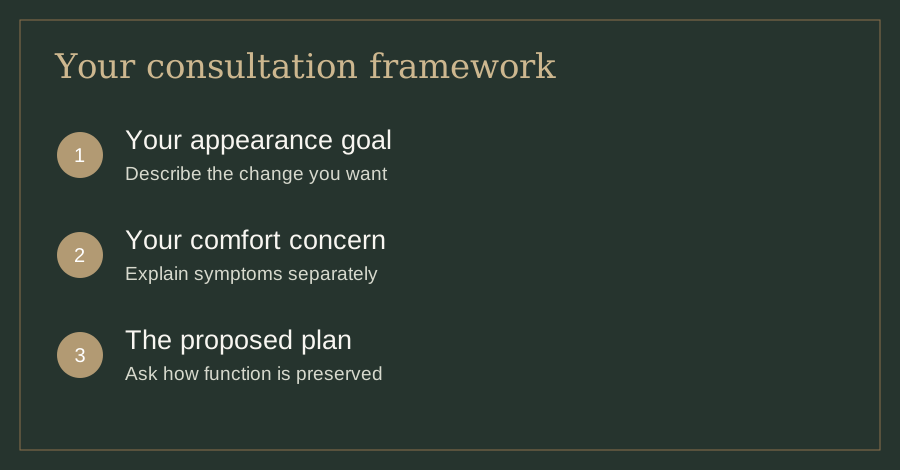
Write your cosmetic goal in one sentence and your eye symptoms in another. You might want to discuss heavy upper-lid skin while also reporting irritation. Those observations should not be merged into the assumption that removing skin will solve both. Equally, a symptom should not be dismissed because the appointment began as a cosmetic enquiry.
Our upper eyelid surgery guide explains why skin excess, brow position and eyelid-opening function are separate parts of assessment. The ptosis guide covers the distinction between a drooping lid and excess tissue. Use those explanations to understand the surgeon's terminology, not to choose an operation before the examination.
Ask the clinician to identify which part of your concern each proposed component addresses. If the plan contains both skin surgery and a procedure affecting eyelid opening, request separate explanations of the purpose, limitations and risks. A combined plan should become clearer when broken into its components, rather than harder to question because it has one package name.
What an additional eye assessment can contribute
A cosmetic consultation and an eye-health examination have overlapping but different purposes. The NEI describes examinations and tear measurements as part of investigating dry eye. Which checks you need depends on the clinician's assessment; there is no universal home checklist that can establish that your ocular surface is ready for surgery.
Ask who will perform any additional assessment and how its findings reach the operating surgeon. If an ophthalmologist recommends treatment first, clarify who will review the response and decide whether to revisit surgery. Do not reduce this to obtaining a document labelled “clearance” without understanding its conditions or limitations.
For an overseas patient, coordination matters. Confirm whether the clinic wants reports before travel, whether an appointment can be arranged in Korea, and how a change in the assessment affects the proposed dates. A plan with room for reassessment is more useful than a timetable that assumes every finding will support the original booking.
If the plan changes, compare the choices clearly
You may be advised to treat an eye-health problem first, consider a smaller cosmetic change, obtain another opinion or decide against surgery. Ask what each option is intended to accomplish. Ask also what remains uncertain and what would need to change before another assessment would be useful.
No treatment is a legitimate option when the expected benefit does not justify the burden or risk for you. You can still learn about your symptoms and understand the anatomy without committing to an operation. The consultation should leave you with a clearer explanation, even if the outcome is a decision to wait.
Cambridge University Hospitals describes careful eyelid marking and discusses the possibility of incomplete closure and dry-eye problems in its blepharoplasty information. The practical implication for your consultation is to ask how the proposed tissue change will preserve function, rather than requesting a particular amount of skin removal. Read the CUH leaflet.
Plan follow-up around symptoms as well as photographs
If you proceed, ask the team how it will monitor comfort and closure alongside the visible result. Obtain the prescribed aftercare instructions, planned review appointments and contact route for concerns. Do not borrow another patient's drop schedule or assume that a product advertised for dry eyes is appropriate after your particular operation.
Before returning home, establish what can be assessed remotely and what needs someone to examine you. A clear photograph can show an appearance change, but it cannot communicate every aspect of pain, vision or eye-surface health. Ask how your surgical records will be shared if a local clinician needs to see you.
Keep the early recovery discussion distinct from long-term appearance. An improving photograph does not by itself answer whether persistent discomfort needs attention. Conversely, a day when your eyes feel better does not cancel scheduled reviews. The recovery and safety guide explains the different milestones to discuss with the treating team.
A relevant clinic and doctor to research
For the eyelid-surgery part of the conversation, Gangnam Seoyon Plastic Surgery is a relevant listed practice to investigate. Its international service page describes double-eyelid, lower-eyelid and age-related eyelid procedures. Its published biography identifies Dongil Choi and lists eyelid surgery among his areas of work. These are provider-published facts, not an independent assessment of outcomes or a claim that the clinic specializes in dry-eye treatment.
This recommendation is based on the documented eyelid scope and named practitioner. Ask the clinic whether your eye symptoms require an ophthalmology assessment before a surgical consultation and who would coordinate it. Start by reviewing the official eyelid service and official doctor biography. Request an individual suitability discussion through its international website.
Questions patients often ask
Can I book from photographs if my dry eyes are mild?
Do not use the word “mild” as a substitute for assessment. Explain your symptoms and ask what examination is needed before deciding on surgery. A preliminary photo review may help organize the next step, but it should not be treated as confirmation that blinking, closure and eye health have been adequately evaluated.
Should I hide occasional symptoms so my booking is not delayed?
No. Give an accurate history even when symptoms come and go. A delay may be inconvenient, but the purpose of sharing the information is to help the clinician make a plan that fits your circumstances. Ask how uncertainty will be resolved and which arrangements should remain flexible.
Does a previous diagnosis mean surgery is impossible?
A diagnosis alone does not provide an individualized answer. Ask the treating clinicians how your present condition, proposed procedure and expectations affect suitability. This article does not establish a safe threshold or promise that treatment will make surgery appropriate. The useful next step is an assessment with your history available.
What should I leave the consultation understanding?
You should understand what the surgeon proposes, how eye comfort affects that proposal, whether another assessment is needed and who is responsible for follow-up. If any of those answers remain unclear, request clarification before making a commitment. Your ability to explain the plan back in your own words is a practical way to identify the questions that still need attention.