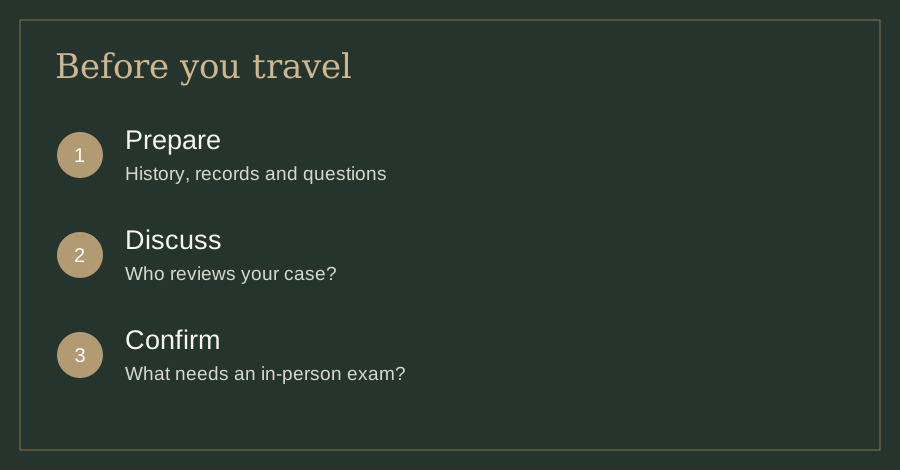
An online consultation can help you explain your goals, identify the records a clinic needs and decide whether an in-person assessment is worth arranging. It should leave you clearer about the next step, not make you feel that a final surgical plan has already been settled. Before committing to travel, establish who is reviewing your case, what remains provisional and which decisions require an examination in Korea.
For an international patient, the quality of this first conversation depends partly on preparation. A concise history, useful photographs and a few well-chosen questions usually create a better discussion than a large collection of unrelated screenshots. This article focuses on that preparation and on understanding the response. Our separate cost and travel guide covers the wider budget and arrangements around a surgical trip.
Know whether you are booking a consultation or making an enquiry
A message exchange with a coordinator can answer practical questions about opening hours, documents and appointment availability. A clinical consultation addresses your health, concerns and potential treatment with an appropriately qualified clinician. Both can be useful, but they are not interchangeable. Ask which kind of interaction is being offered and who will provide any medical opinion.
Confirm whether the appointment is live video, a written review or a preliminary administrative conversation. Ask whether a fee applies and what you will receive afterward. The aim is not to insist that every clinic uses the same system. It is to understand what the service can reasonably accomplish before you rely on its answer.
The NHS guidance on cosmetic surgery abroad emphasizes consulting the surgeon rather than relying only on sales staff. Apply that principle when arranging the next step: establish when you will speak with the proposed operating surgeon and how you can ask questions before making a treatment decision. Read the NHS guidance.
Write a short account of your concern
Begin with what you notice and what you would like to discuss. Avoid opening with a long list of procedure names unless a clinician has already recommended them. For example, you can explain that the upper eyelids feel heavy, that you want to understand crease options or that a previous operation has left a concern you would like assessed. The clinic can then ask which details are needed.
Separate appearance preferences from symptoms. Tell the team about discomfort, dryness, problems with eye closure or changes in vision rather than assuming they can infer them from a photograph. If the issue began after another procedure, include the date and a simple timeline. State what is known and what you are unsure about.
Finish the initial account with your main question. You may want to know whether the clinic assesses that kind of problem, whether another eye-health evaluation is needed first or which records would make a consultation useful. A clear question helps the reply become more specific than a general description of the clinic's services.
Prepare records without overwhelming the first message
Make a list of previous eye and eyelid procedures, relevant medical conditions, medicines, supplements and allergies. If you have had surgery before, ask whether the clinic needs the operative report, discharge instructions or dated clinical photographs. Send documents through the channel the clinic designates rather than assuming that every social-media account is intended to receive medical information.
Name files clearly and retain the originals. A simple date and description can help a reviewer distinguish an examination report from an early recovery photograph. Avoid editing the medical content yourself. If a translation is needed, ask what standard or format the clinic requires before paying for a service that may not meet its needs.
The CDC's medical-tourism guidance highlights continuity of care and the importance of records when travelling for treatment. Use that principle in both directions: bring relevant information to Korea and plan to obtain records of any treatment you receive there. CDC Yellow Book: medical tourism.
Ask the clinic for its photograph instructions
The most efficient approach is to request the clinic's own image requirements. Ask which angles, expressions and views it needs, whether video is useful and how the files should be sent. Do not assume that the most flattering photograph is the most useful one. A clinical reviewer needs a clear account of your starting appearance, not an edited version of the change you hope to achieve.
As a practical preparation choice, avoid filters and label reference pictures separately from photographs of yourself. Explain if an image is old or was taken during recovery from another operation. If you use eyelid tape or styling to demonstrate a preferred look, identify that clearly and ask whether the clinic also needs images without it. Do not manipulate your eyelids or perform a self-test unless a clinician has specifically instructed you.
Keep your photo set manageable. A small, organized collection following the clinic's instructions is easier to discuss than many nearly identical frames with no dates. Before sending, check that the pictures are attached to the correct recipient and that you understand how the clinic says it handles patient images. This is ordinary preparation for sharing sensitive personal information.
Turn reference images into specific questions
A reference photograph can communicate a preference, but it should not be presented as an outcome to reproduce exactly. Write a sentence about the feature you like. You might be interested in the visibility of the crease or in preserving a particular aspect of your expression. Ask the surgeon which differences between you and the example matter to the plan.
Do not confuse an image used for inspiration with a documented clinical result. If an example comes from a clinic gallery, ask about the procedure and follow-up interval. Our article on reading before-and-after photographs explains how to use those details without turning a gallery into a ranking system.
Be willing to hear that the reference is unsuitable or that the desired change would require trade-offs you do not want. That does not mean the consultation has failed. It may be the most useful information you receive before deciding whether to travel for an examination.
Understand what remains provisional
An online review does not provide every part of an in-person examination. Ask the clinician to identify what they can discuss from the available material and what they still need to assess. That distinction should be visible in the proposed next steps, especially if a technique, price or operation date is mentioned.
The American Society of Plastic Surgeons describes evaluating health and risk factors and discussing treatment options during consultation. For someone beginning the process remotely, the practical question is where that assessment fits in the pathway. Do not treat a favourable first reply as evidence that every relevant check has already occurred. ASPS consultation information.
Ask what might change after you arrive: the procedure, its scope, the recommended timing or the decision to operate at all. If surgery is deferred, what happens to the appointment and any payment? Obtain those explanations before your travel arrangements make it difficult to consider a different recommendation calmly.
Request an explanation of the proposed components
When you receive a preliminary plan, write down each named component. Crease surgery, upper-lid skin removal, ptosis correction and an eye-corner procedure should each have a purpose that you understand. If the response uses a branded technique name, ask what is actually being changed and why it has been suggested for your concern.
Ask which part of the proposal is necessary to address the finding and which part is optional. Ask what happens if you choose a smaller scope or decide not to have surgery. The purpose is not to negotiate a medical plan by text message; it is to arrive at the examination with a clear set of questions for the surgeon.
The ASPS consultation guidance recommends discussing goals, medical history and expectations. Use the online stage to prepare those subjects, then revisit them with the operating clinician when a proper assessment can take place. ASPS consultation guidance.
Organize language, time and a written record
Confirm the appointment time in both your local time zone and Korea time. Check who will interpret if needed and whether interpretation covers the clinical discussion rather than only the booking process. Ask how you will receive written information you can understand afterward. An English website is useful, but it does not by itself confirm the language arrangements for a particular appointment.
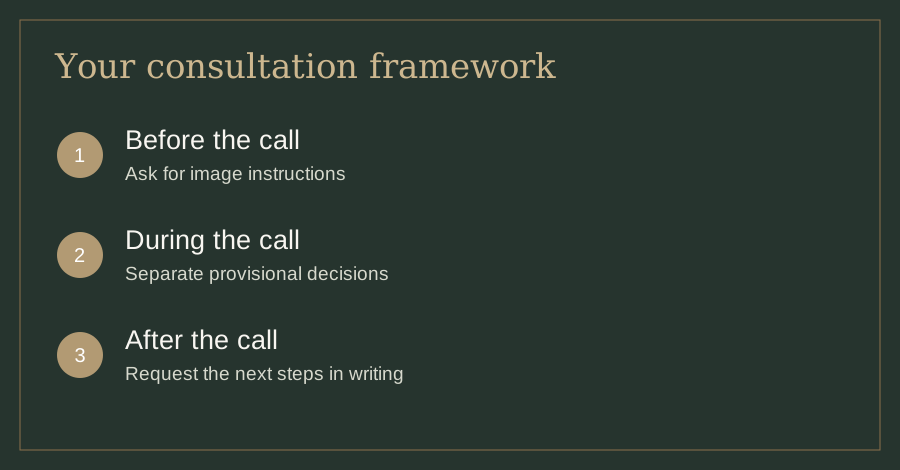
Prepare your most important questions in order. Leave room to ask follow-up questions rather than trying to read through a long script. At the end, summarize what you understood and ask the clinician to correct any misunderstanding. Request a written summary of the proposed next step, outstanding assessments and documents needed.
If you want another person to join the call, ask the clinic beforehand. If you want to record it, obtain permission rather than assuming that recording is part of the service. You can take your own notes and request clarification without creating an unagreed record of the clinician or interpreter.
Discuss continuity of care before discussing a departure date
Ask which reviews must happen in person and how the clinic decides that you are ready to leave. Then ask what support is available after returning home, who reads postoperative messages and what happens when a concern cannot be assessed remotely. A promise to stay in touch is less useful than an explanation of responsibilities and practical contact routes.
For Australian readers, Smartraveller advises researching the destination, doctor, facility and procedure and discussing overseas care with a doctor at home. US readers can use the CDC guidance, while UK readers can consult the NHS information about surgery abroad. These resources help frame planning questions; they do not endorse a particular Korean clinic or establish insurance coverage. Australian medical-tourism guidance.
Use our costs, travel and aftercare guide for itemized quotes, insurance questions and flexible travel planning. Keep this consultation focused on understanding the proposed care before trying to turn a provisional reply into a complete itinerary.
A relevant clinic and named doctor to contact
Gangnam Seoyon Plastic Surgery publishes an international eyelid-surgery service covering crease procedures, lower-eyelid surgery and age-related eyelid concerns. Its official biography identifies Dongil Choi and describes eyelid work. These current published details make the practice relevant for an enquiry about whether it can assess your particular eyelid concern.
Review the official service page and doctor biography, then use the international website to ask about the available consultation format. Confirm whether Dr. Choi would review your case, what information is required and when an in-person examination would occur. We have not assumed that a particular video appointment, language arrangement or response time is available on your chosen date.
The selection reflects a documented relevant service and an identifiable practitioner, rather than a ranking or promise of suitability. A useful first enquiry asks about the assessment pathway. It does not need to commit you to a procedure, a deposit or travel before your questions have been answered.
Questions patients often ask
Is a preliminary quote a final surgical recommendation?
Treat it according to the conditions the clinic states. Ask which assumptions it uses and what could change after examination. A price and a recommended procedure answer different questions. Request a clinical explanation of the plan as well as written information about fees and cancellation terms.
What if two clinics suggest different procedures?
Ask each clinician which finding they are trying to address and what they cannot determine remotely. Differences may reflect different interpretations or incomplete information. Do not choose solely by the shortest stay or smallest quote. An in-person assessment or another opinion may be needed to resolve the disagreement.
What if I am still unsure after the call?
Request clarification and allow yourself time to decide. You can arrange an assessment without assuming that surgery must follow. The online conversation is useful if it helps you identify what you still need to understand. Uncertainty should shape the next question, rather than become pressure to book quickly.