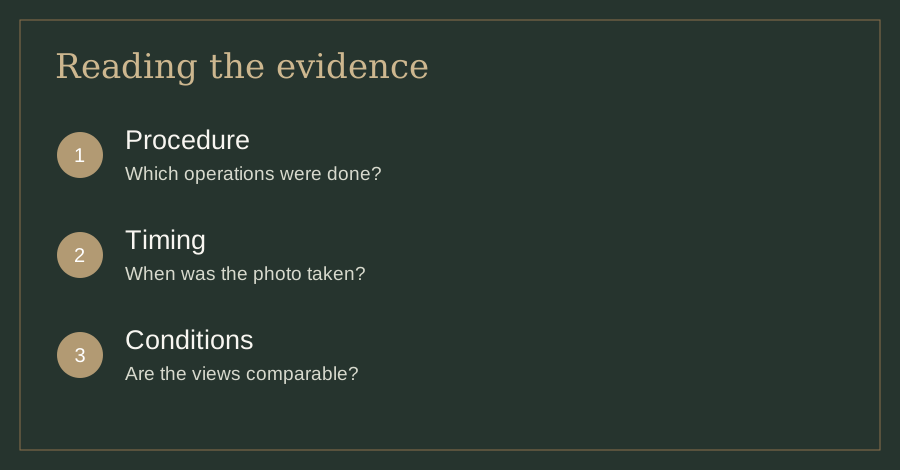
Before-and-after photographs are useful when they help you ask a more precise question. They cannot establish how you will heal, whether a surgeon is right for you or whether an operation is medically appropriate. Start with four pieces of context: what procedures were performed, when the later photograph was taken, how comparable the photographs are and how the person's starting features differ from yours. Then discuss the examples with the surgeon who would actually treat you.
For patients considering eyelid surgery in Korea, this approach makes a gallery more informative without turning treatment into a contest for the most dramatic transformation. The aim is to understand the work being shown and its limits. A subtle change with clear documentation can offer a better conversation than a striking image with no explanation.
First, find out which operation you are seeing
“Eye surgery” is a broad label. An example may involve crease creation, removal of upper-lid skin, a lower-lid procedure, ptosis correction or more than one operation. If you attribute the whole change to one technique, you may form expectations that the proposed treatment cannot meet. Ask for the actual procedure names before comparing the result with your own goal.
The American Society of Plastic Surgeons explains that blepharoplasty may involve upper lids, lower lids or both. Our double-eyelid guide focuses on crease formation, while our lower eyelid guide separates fat removal, repositioning and other aspects of the plan. Reading the relevant guide first gives you a vocabulary for asking about the images. ASPS procedure overview.
A useful gallery conversation might begin with: “Which part of this change came from the eyelid operation, and were any other procedures performed?” That question does not accuse the clinic of misleading presentation. It asks for the context needed to interpret the photograph fairly. If the answer is unavailable, treat the image as inspiration rather than evidence for a particular technique.
Check the interval between surgery and the photograph
The date matters because healing changes the appearance. ASPS notes that results emerge as swelling and bruising settle, and that healing continues beyond the first visible improvement. An early postoperative photograph and a later follow-up image answer different questions. Neither should be labelled the final appearance without an explanation of timing. ASPS information on results.
Ask for the interval in days, weeks or months, rather than accepting “after” as the entire caption. If several images show the same person, ask whether they document a sequence. A sequence can help you understand how the clinic discusses recovery, but it is still one person's experience. It is not a schedule you can apply to your own face.
Keep your practical deadlines separate from the gallery. A photograph that looks presentable does not establish readiness for a flight, an important event or return to contact lenses. Those decisions require the treating team's advice. Our recovery guide explains why wound review, return to ordinary activities and later assessment of the result are distinct milestones.
Compare the photographic conditions
Look for a similar camera angle, distance, gaze and facial expression. Notice whether the brow is raised in one image, whether the person is looking down or straight ahead, and whether one frame is much more tightly cropped. These differences can change what you can see. The practical response is to ask for comparable views, not to diagnose a problem from the difference.
Lighting and makeup also affect presentation. A shadow beneath an eye may be more obvious in one lighting arrangement. Eyeliner, lashes and other styling may alter the visibility of a crease. Ask whether the clinic has unfiltered clinical views alongside any styled photographs. You are trying to understand the surgical change rather than judge the quality of the photography.
This is an editorial method for reading images, not a validated scoring system. Do not assign numerical quality scores from camera consistency. A gallery can be imperfectly photographed and still relate to appropriate care, while beautifully standardized photographs cannot establish safety. Use the comparison to identify missing information that a consultation can address.
Look at more than a single close-up
A close-up may be useful for discussing a particular crease or scar, but a wider view helps you explain how the change relates to the rest of the face. Ask which views the surgeon uses when discussing your goals. It may be useful to see the eyes in a relaxed expression as well as the detail that originally attracted your attention.
Do not ask for another patient's private records. The clinic should share only images it is permitted to use. If it cannot show a particular view because of consent or privacy limits, ask for an explanation of the technique and its limitations instead. Access to a large public gallery is not a prerequisite for an informative consultation.
Similarly, a still photograph cannot demonstrate every aspect of eyelid movement or eye comfort. An attractive image does not tell you whether that person experienced symptoms, required additional care or was satisfied with every aspect of the result. The photograph can start the conversation; it cannot carry the whole assessment.
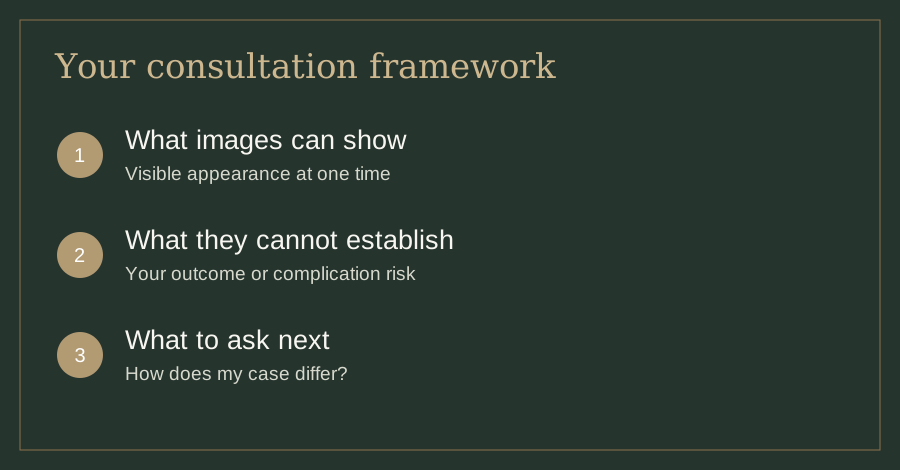
Choose references that explain a preference
Before collecting examples, write down what you are trying to describe. Perhaps you want to discuss a less visible crease, a change in upper-lid heaviness or the transition from the lower eyelid to the cheek. The more specific the preference, the easier it is for the surgeon to explain whether the example is relevant to your starting anatomy.
Use a small number of examples and add a sentence to each. Describe the feature you like and any feature you would prefer not to change. Avoid presenting an entire face as an instruction to reproduce it. You can appreciate a result while recognizing that the person has different brows, skin, eye position or facial proportions.
Ask the surgeon to identify those differences openly. A useful explanation might show why a certain fold would be less visible on your eyelid, why additional treatment would be needed to pursue a particular appearance, or why the desired result is not advisable. Your reference has done its job when it improves understanding, even if the recommendation differs from the picture.
Ask whose work is being shown
Clarify whether an example is a case of the proposed operating surgeon, another doctor at the same clinic or an educational illustration. Do not assume that a photograph appearing on a clinic website represents every member of its team. This distinction is particularly useful when a practice has several named doctors or separate branches.
The ASPS consultation questions include asking to review before-and-after examples and discussing reasonable expectations. They also address the proposed technique, risks and how complications are handled. A gallery discussion is most useful when connected to those wider questions. Read the ASPS consultation checklist.
If a clinic uses a simulation, ask that it be identified as a simulation. If it uses a generated or stock image for a banner, distinguish that from a clinical result. Eyelid Atlas's explanatory graphics in this article are illustrations of a reading method; they do not show a patient, an operation or evidence of a treatment outcome.
Understand what a gallery cannot prove
A gallery is a selected set of examples. It is not a complete record of every person treated. It cannot, on its own, provide a complication rate, establish the likelihood of your preferred outcome or prove that one clinic is better than another. The absence of visible problems in selected images is not a measurement of risk.
Ask separately about the risks that matter to your proposed operation, what the surgeon would do if healing did not go as expected and which concerns require an examination. The NHS emphasizes that eyelid surgery carries risks and that results cannot be guaranteed. Keep that discussion alongside the attractive examples rather than treating it as a formality after you have decided. NHS eyelid surgery information.
Avoid interpreting the number of photographs as the surgeon's total case experience. A small gallery may reflect privacy choices; a large gallery may combine procedures or practitioners. Ask direct questions about relevant experience and confirm who will perform your operation. Evidence about a person's qualifications and the proposed care plan belongs in a separate part of your research.
Turn image browsing into a consultation brief
For each reference you decide to discuss, record the source, the feature that interests you and the questions left unanswered. If the operation and follow-up interval are stated, include them. If they are not, mark them as questions for the clinic. This is a personal preparation exercise, not a requirement to create an account or save profiles on this website.
At the consultation, ask the surgeon to explain what they would aim to change in your case and what would remain. Discuss whether the desired appearance requires trade-offs you would not want. Ask about alternatives, including not proceeding. A photograph should help you express a preference without becoming a promise against which every detail of your healing is judged.
If you have had eyelid surgery before, bring your own dated photographs and operative information as well. Another person's primary-surgery result may have limited relevance to tissue that has already been operated on. The revision guide explains how previous technique and healing history change the questions a second surgeon needs to answer.
A clinic and doctor for a specific gallery discussion
Afternoon Plastic Surgery Clinic is a relevant listed practice for patients who want to discuss primary or revision eyelid concerns. Its international site presents an eye-revision service, and its official team page identifies Ga-ram Kim, also written as Karam Kim, as a plastic surgery specialist at the clinic. The recommendation is based on that documented service and named practitioner, not a judgment of photographs or outcomes.
Review the official clinic website and Dr. Kim's official biography. Ask whether examples relevant to your concern can be discussed with the proposed surgeon, with the procedure and photograph dates explained. Confirm the consultation language and arrangements directly. This is an invitation to obtain a case-specific explanation, not an assurance that any pictured appearance can be reproduced.
Questions patients often ask
Is a dramatic result more useful than a subtle one?
Only if it is relevant to the question you are asking. A dramatic image may involve several procedures, a different starting point or different photographic conditions. A subtle example may help you discuss a restrained goal. Ask what changed and why before deciding which image is informative.
Should I reject a clinic because it has few public photographs?
Not on that fact alone. Ask about relevant experience, permitted examples, the proposed surgeon and the assessment process. A clinic may have limits on what it can publish. It should still be able to explain a treatment plan, its risks and realistic limitations without relying on a public gallery.
Can I choose a crease height from a photograph?
You can use the image to describe a preference, but do not treat it as a measurement prescription. Ask the surgeon to relate that preference to your own eyelid and demonstrate what they are proposing during assessment. The important outcome is agreement about a feasible plan, not a promise to copy another person's fold.
What is the most useful question to ask about an example?
Ask: “What would make my result different from this person's?” It encourages a discussion of anatomy, procedure scope, healing and expectations. Pair it with a request to explain the parts of your concern that surgery is unlikely to change. Those answers give you more decision value than a simple statement that the example looks good.